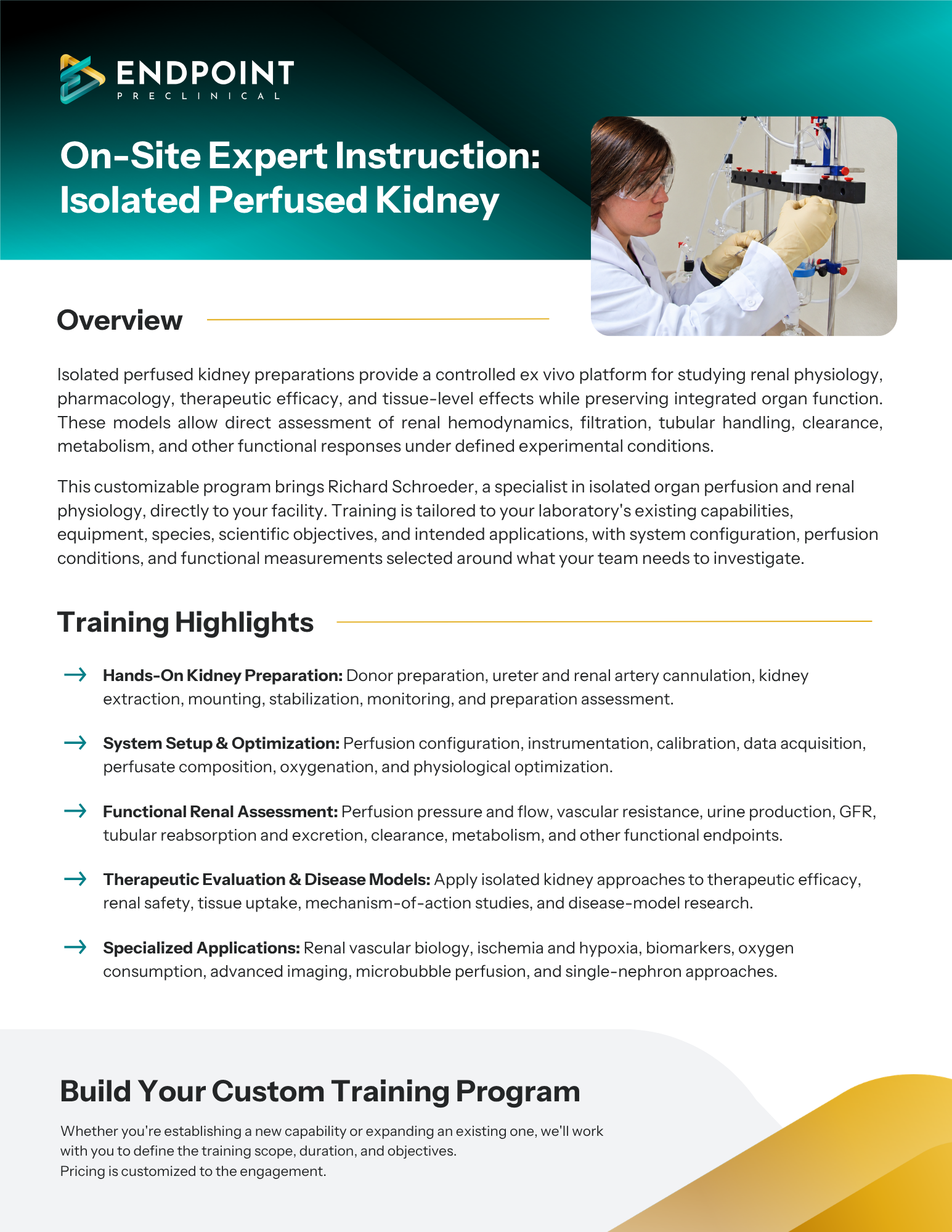

On-Site Expert Instruction: Isolated Perfused Kidney
Build, optimize, or expand your laboratory’s isolated kidney research capability through hands-on training tailored to your science, equipment, and research objectives.
Isolated perfused kidney preparations provide a controlled ex vivo platform for studying renal physiology, pharmacology, therapeutic efficacy, and tissue-level effects while preserving integrated organ function. Positioned between cell-based assays and more complex in vivo studies, these models allow direct assessment of renal hemodynamics, filtration, tubular handling, clearance, metabolism, and other functional responses under defined experimental conditions.
Our customizable Isolated Perfused Kidney Training Program provides direct access to Richard Schroeder, an experienced cardiovascular, renal, metabolic, and cardiorenal research specialist who has developed and applied isolated-organ models across pharmaceutical, biotechnology, CRO, and research environments.
Training is delivered at your facility using your laboratory’s equipment and workflows. Rather than teaching a fixed method, Richard works with your team to configure the preparation around your scientific objectives, whether you are establishing a new capability, optimizing an existing system, expanding functional endpoints, or incorporating specialized renal applications.
Training Highlights:
- Customized on-site training: Flexible, multi-day instruction tailored to your team, equipment, species, research objectives, and system configuration.
- Model design and experimental planning: Species, perfusion strategy, system configuration, and endpoints aligned with the scientific question.
- Hands-on kidney preparation: Donor preparation, ureter and renal artery cannulation, kidney extraction, positioning, stabilization, and monitoring.
- System setup and experimental optimization: Instrumentation, calibration, perfusion configuration, data acquisition, sample collection, and preparation assessment.
- Perfusate and physiological optimization: Perfusate composition, oncotic agents, oxygenation, and other conditions affecting renal function and downstream analyses.
- Renal function assessment and data interpretation: Vascular pressure and flow, resistance, urine production, GFR, clearance, reabsorption/excretion, albuminuria, metabolism, and other functional endpoints.
- Therapeutic delivery and tissue uptake: Assessment of therapeutic distribution within the kidney and resulting organ-level responses.
- Specialized applications: Renal vascular biology, ischemia and hypoxia, biomarkers, disease models, ultrasound, microbubble perfusion, advanced imaging, and single-nephron approaches.
- Troubleshooting and scientific guidance: Support for reproducible preparation, data quality, and physiologically meaningful interpretation.
Example Training Experience
For laboratories establishing a new capability, planning can begin before equipment is purchased. Richard can help define system and instrumentation requirements, identify necessary components and supplies, and determine how the platform should be configured for its intended applications.
Get the physiological and experimental context needed to understand how and why the preparation is configured for your research. Common topics include:
- Applications and limitations of isolated perfused kidney preparations;
- Constant-flow versus constant-pressure and single-pass versus recirculating perfusion;
- Perfusate composition, oncotic agents, and other physiological considerations;
- Renal hemodynamics, glomerular filtration, tubular function, and urine collection; and
- Preparation stability, functional validation, and endpoint selection.
Richard works directly with participants through the complete preparation, from system setup through a stable, instrumented kidney preparation. Training can include:
- Perfusion system preparation, data acquisition, and calibration;
- Surgical setup, donor preparation, and kidney exposure;
- Ureter isolation and cannulation for urine collection;
- Renal artery cannulation, kidney extraction, and placement within the perfusion system;
- Establishment of perfusion, stabilization, and functional monitoring; and
- Sample collection, preparation assessment, and troubleshooting.
The objective is to establish a stable, reliable preparation that is ready for the laboratory’s functional study protocol.
Once a reliable preparation is established, training progresses to the functional measurements most relevant to the laboratory’s model and research question. Depending on the application, this can include:
- Renal perfusion pressure, blood flow, and vascular resistance;
- Urine production and osmolality;
- Glomerular filtration rate, fractional reabsorption and excretion, and renal clearance;
- Albuminuria and renal biomarkers;
- Metabolic measurements and oxygen consumption;
- Tissue perfusion and preparation stability; and
- Specialized application-specific measurements.
Richard also works with participants to evaluate expected physiological ranges, recognize experimental artifacts and poor-quality preparations, and determine whether the resulting data are reliable for interpretation.
Once the core preparation is working reliably, training can extend into applications relevant to your research program. Depending on your objectives, this can include:
- Renal vascular and hemodynamic studies;
- Disease-model applications;
- Therapeutic efficacy and renal safety assessment;
- Metabolic studies;
- Ischemia and hypoxia;
- Biomarker applications;
- Therapeutic delivery and tissue uptake; and
- Advanced imaging.
The first step to building your training program is providing information about your team, current gaps, and training goals. Click below to complete our questionnaire.
Alternatively, email your training requirements to [email protected], and a member of our team will help build your training experience.
Instructor:

Richard Schroeder, BS, RVT, LAT
Expert in Isolated Organ Models, Translational Physiology, and Technical Training
Richard Schroeder brings more than 40 years of experience in preclinical drug discovery, experimental physiology, and model development across pharmaceutical, biotechnology, and contract research environments. His expertise includes isolated perfused kidney models, renal hemodynamics, glomerular filtration, vascular function, therapeutic evaluation, and advanced physiological data analysis.
His experience spans whole-animal and isolated-organ research, including renal ultrasound, tissue perfusion, and specialized imaging. Through training, Richard supports laboratories in model development, system optimization, functional assessment, troubleshooting, and scientific interpretation. View Richard’s Profile
Frequently Asked Questions:
Each engagement includes a customized training plan developed around your laboratory’s objectives, system configuration, and intended applications.
Additional reference materials, protocols, troubleshooting resources, or other application-specific materials may also be incorporated where useful to the particular training program.
Yes. The training experience can include a limited amount of follow-up consultation and data review related to the original engagement, helping your team apply what was learned once you begin working independently.
Additional scientific support can also be provided as your program evolves, including protocol development, experimental design, system optimization, troubleshooting, review of newly generated data, advanced analysis and interpretation, addition of new endpoints, development of specialized renal models, and expansion into new therapeutic applications.
Yes. For laboratories already operating an isolated perfused heart system, adding kidney capability may be a natural extension of existing infrastructure.
Kidney preparation, cannulation techniques, physiological endpoints, and experimental considerations are distinct enough to require dedicated training. However, some perfusion equipment, system components, and data acquisition infrastructure may be adaptable between applications.
Yes. The program is not limited to laboratories establishing an isolated kidney model for the first time.
Training can be tailored to teams looking to troubleshoot an existing preparation, improve reproducibility, transfer knowledge to new scientists, expand the endpoints they can measure, develop specialized applications, or add new disease models, imaging approaches, or advanced functional assessments.
The specific requirements depend on your intended preparation, measurements, and applications.
Before training begins, Endpoint will work with your team to define the goals of the engagement and confirm that the necessary equipment, supplies, consumables, and other resources are available. Richard will also help develop a customized training plan and checklist to guide the engagement.
For laboratories establishing a new capability, this planning can begin before equipment is purchased.
Yes. Each program is built around your team’s experience, system configuration, species, therapeutic area, research objectives, and intended applications.
Depending on your goals, training can address system configuration, kidney preparation, perfusion strategy, perfusate selection, renal hemodynamics, filtration and tubular endpoints, metabolism, biomarkers, therapeutic delivery, advanced imaging, or other specialized renal applications.
Training is delivered on-site at your facility using your laboratory’s equipment, systems, and workflows. This allows the training to address your specific system configuration and the conditions your team will encounter when applying the techniques independently.
Training is delivered as a flexible, multi-day experience. The duration and agenda are customized based on your team’s existing experience, system configuration, scientific objectives, and the applications or endpoints you want to establish or expand.
No. Training can support laboratories with an established isolated kidney system as well as teams that are still building their capability.
If your laboratory has not yet purchased a system, consultation can begin before equipment is ordered. Richard can help your team define the intended applications, evaluate system and instrumentation requirements, identify necessary components and supplies, and determine how the platform should be configured around your scientific objectives.