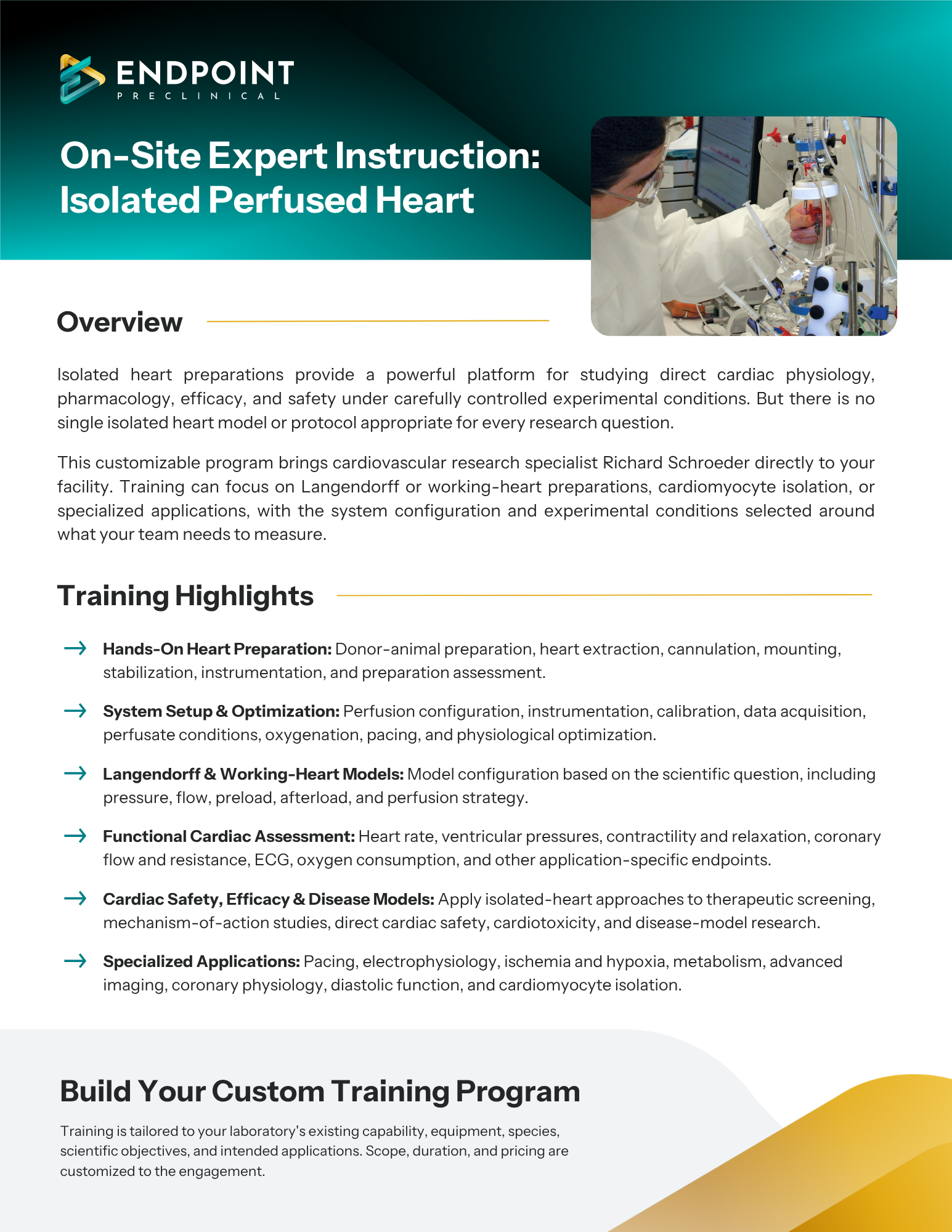

On-Site Expert Instruction: Isolated Perfused Heart
Build, optimize, or expand your laboratory’s isolated heart research capability through hands-on training tailored to your science, equipment, and research objectives.
Isolated heart preparations provide a controlled platform for studying direct cardiac physiology, pharmacology, efficacy, and safety. Positioned between cell-based assays and more complex in vivo studies, these models provide organ-level functional information while allowing greater control over experimental conditions.
Our customizable Isolated Perfused Heart Training Program provides direct access to Richard Schroeder, an experienced cardiovascular, renal, and metabolic research specialist who has developed and applied isolated heart models across pharmaceutical, biotechnology, CRO, and research environments.
Training is delivered at your facility using your laboratory’s equipment and workflows. Rather than teaching a fixed method, Richard works with your team to identify the preparation, system configuration, and experimental conditions suited to your research objectives, whether your program involves Langendorff or working-heart preparations, cardiomyocyte isolation, or specialized isolated-heart applications.
Training Highlights:
- Customized on-site training: Flexible, multi-day instruction tailored to your team, equipment, species, research objectives, and system configuration.
- Langendorff and working-heart training: Model configuration aligned with the scientific question and experimental objectives.
- Hands-on heart preparation: Donor preparation, heart extraction, cannulation, mounting, stabilization, and monitoring.
- System setup and experimental optimization: Instrumentation, calibration, perfusion configuration, data acquisition, and preparation assessment.
- Perfusate and physiological optimization: Calcium, energy substrates, oxygenation, heart rate, pacing, and other variables affecting cardiac performance.
- Functional cardiac assessment and data interpretation: Measurements and analysis aligned with the preparation and study endpoints.
- Drug efficacy, cardiac safety, and cardiotoxicity: Whole-organ assessment of therapeutic and direct cardiac effects.
- Specialized applications: Pacing, electrophysiology, contractility, diastolic function, coronary physiology, ischemia/hypoxia, metabolism, and more.
- Troubleshooting and scientific guidance: Support for reproducible preparation, data quality, and physiologically meaningful interpretation.
Include the Approaches Relevant to Your Research
Langendorff preparations use retrograde perfusion of the coronary circulation and can be configured for either constant coronary pressure or constant coronary flow.
Training can address system configuration, heart preparation and cannulation, pacing, perfusion conditions, ventricular pressure measurements, coronary flow, contractility, relaxation, electrophysiology, metabolic considerations, and specialized applications.
Langendorff preparations can support applications ranging from direct pharmacological and cardiac safety evaluation through contractility, coronary physiology, pacing, metabolism, disease-model studies, and advanced functional assessment.
For research questions requiring a working-heart preparation, training can instead focus on configuring the isolated heart to operate under physiologically relevant loading conditions.
Working-heart model design can include consideration of variable or constant left ventricular end-diastolic pressure, peripheral resistance, preload, afterload, perfusion strategy, and functional endpoints.
The appropriate configuration is selected and optimized around the laboratory’s intended application rather than treating working-heart and Langendorff modes as interchangeable approaches.
Training can focus specifically on cardiomyocyte isolation, including system setup, heart preparation, and the isolation of viable ventricular and/or atrial cardiomyocytes.
Consistent, high-quality isolation is critical when cells will be used for downstream applications such as calcium imaging, contractility measurements, electrophysiology, or other cell-based assays where cell viability and preparation quality can directly affect experimental results.
Example Training Experience
For laboratories establishing a new capability, this planning can begin before equipment is purchased. Richard can help define system and instrumentation requirements, identify necessary components and supplies, and determine how the platform should be configured for its intended applications.
Get the physiological and experimental context needed to understand how and why the preparation is configured for your research. Common topics include:
- Capabilities, limitations, and selection of Langendorff versus working-heart preparations;
- Perfusion strategy, pressure, flow, preload, afterload, and cardiac work;
- Heart rate, pacing, perfusate composition, calcium, and metabolic substrates;
- Preparation quality, stability, and functional endpoint selection; and
- How experimental conditions influence data interpretation.
Richard works directly with participants through the complete preparation for their selected model, from system setup through a stable, instrumented heart preparation. Training can include:
- Perfusion system preparation, testing, data acquisition, and calibration;
- Surgical setup, donor-animal anesthesia, and positioning;
- Heart extraction, cardioplegia, and myocardial preservation;
- Cannulation, mounting, and establishment of perfusion;
- Stabilization, acclimation, and instrumentation; and
- Preparation quality assessment and troubleshooting.
The objective is to establish a stable, reliable preparation that is ready for the laboratory’s functional study protocol.
Once a reliable preparation is established, training progresses to the functional measurements most relevant to the laboratory’s model and research question. Depending on the application, this can include:
- Heart rate and ventricular pressure measurements;
- Contractility and relaxation, including +dP/dt, −dP/dt, Tau, and isovolumic relaxation time;
- Coronary flow and resistance;
- ECG and oxygen consumption;
- Preparation stability and experimental response; and
- Specialized application-specific measurements.
Richard also works with participants to evaluate expected physiological ranges, recognize experimental artifacts and poor-quality preparations, and determine whether the resulting data are reliable for interpretation.
Once the core preparation is working reliably, training can extend into applications relevant to your research program. Depending on your objectives, this can include:
- Advanced functional protocols;
- Disease-model applications;
- Therapeutic screening;
- Direct cardiac safety and cardiotoxicity assessment;
- Metabolic experiments;
- Electrophysiology;
- Advanced imaging; and
- Cardiomyocyte isolation.
The first step to building your training program is providing information about your team, current gaps, and training goals. Click below to complete our questionnaire.
Alternatively, email your training requirements to [email protected], and a member of our team will help build your training experience.
Instructor:

Richard Schroeder, BS, RVT, LAT
Expert in Isolated Organ Models, Translational Physiology, and Technical Training
Richard Schroeder brings more than 40 years of experience in preclinical drug discovery, experimental physiology, and model development across pharmaceutical, biotechnology, and contract research environments. His expertise includes Langendorff and working-heart preparations, cardiovascular pharmacology, cardiac safety, electrophysiology, coronary physiology, and advanced functional assessment.
His experience spans isolated-heart research across multiple species, including specialized applications in cardiac metabolism, ischemia and hypoxia, disease models, and cardiomyocyte isolation. Through training, Richard supports laboratories in model development, system optimization, experimental design, troubleshooting, and scientific interpretation. View Richard’s Profile
Frequently Asked Questions:
This program can support:
- Pharmaceutical and biotechnology laboratories establishing a new isolated heart capability;
- Small biotech and biopharma companies seeking organ-level evidence between cell-based assays and more complex in vivo studies;
- Established cardiovascular groups looking to rebuild, transfer, or expand internal expertise;
- Drug-discovery teams using isolated heart studies for efficacy screening, target validation, mechanism-of-action research, compound differentiation, or cardiac safety assessment;
- Laboratories adding Langendorff or working-heart capabilities to an existing cardiovascular platform;
- Groups developing cardiomyocyte isolation capabilities for downstream cellular research;
- CROs seeking to establish or expand isolated-heart services;
- Academic and core laboratories developing specialized cardiac physiology capabilities; and
- Experienced isolated-heart laboratories looking to add new endpoints, species, disease models, or specialized applications.
Training is delivered on-site at your facility using your laboratory’s equipment, systems, and workflows. This allows the training to address the conditions your team will encounter when applying the techniques independently.
The specific requirements depend on your intended preparation and applications.
Before training begins, Endpoint will work with your team to define the goals of the engagement and confirm that the necessary equipment, instrumentation, supplies, consumables, and other resources are available. Richard will also help develop a customized training plan and checklist to guide the engagement and ensure the agreed objectives are addressed.
For laboratories establishing a new capability, this planning can begin before equipment is purchased.
Yes. The training experience can include a limited amount of follow-up consultation and data review related to the original engagement, helping your team apply what was learned once you begin working independently.
Additional scientific support can also be provided as your program evolves, including protocol development, experimental design, system optimization, troubleshooting, data review, advanced analysis, interpretation of unexpected findings, development of additional endpoints, and expansion into new isolated-heart applications.
Training is delivered as a flexible, multi-day experience. The duration and agenda are customized based on your team’s existing experience, system configuration, scientific objectives, and the applications you want to establish or expand.
No. Training can support laboratories with an established isolated heart system as well as teams that are still building their capability.
If your laboratory has not yet purchased a system, consultation can begin before equipment is ordered. Richard can help your team define the intended applications, evaluate system and instrumentation requirements, identify necessary components and supplies, and determine how the platform should be configured around your scientific objectives.
Yes. Once the foundational preparation is established, training can be extended into applications relevant to your research program.
Depending on your objectives, this may include cardiac pacing and heart-rate control, electrophysiology and arrhythmia, contractility and inotrope profiling, diastolic function, coronary physiology, cardiac safety and cardiotoxicity, ischemia and hypoxia, cardiac metabolism, disease-model applications, advanced cardiac imaging, or cardiomyocyte isolation.
Yes. The program is not limited to laboratories establishing an isolated heart model for the first time.
Training can be tailored to teams looking to troubleshoot or optimize an existing preparation, improve reproducibility, train new staff, add new endpoints or applications, expand into different species or disease models, or rebuild and transfer internal expertise.
Yes. The program is built around your team’s experience, equipment, species, therapeutic area, research objectives, and intended applications.
Depending on your goals, training may focus on Langendorff preparations, working-heart preparations, cardiomyocyte isolation, or specialized applications. Richard works with your team to determine the preparation, system configuration, experimental conditions, and functional endpoints best suited to what you are trying to measure.
Each engagement includes a customized training plan developed around your laboratory’s objectives, system configuration, and intended applications.
Additional reference materials, protocols, troubleshooting resources, or other application-specific materials may also be incorporated where useful to the particular training program.