

On-Demand Webinar: Beyond Muscle Mass: What Murine Muscle Function Reveals
On-Demand Webinar: Beyond Muscle Mass: What Murine Muscle Function Reveals
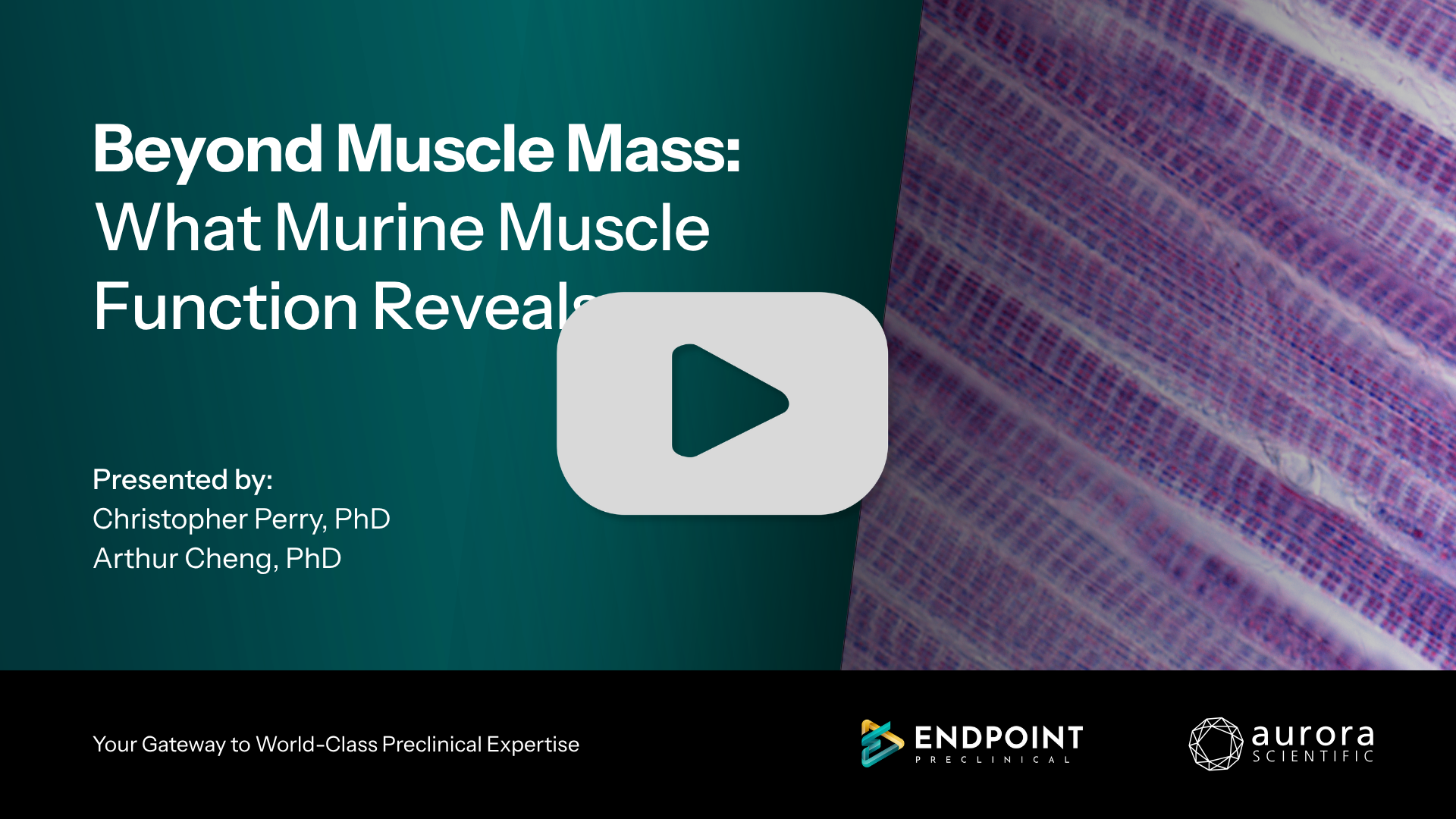
Muscle mass, histology, and molecular findings provide important context in skeletal muscle research, yet they may not fully explain changes in force generation, fatigue resistance, contractile speed, recovery, or susceptibility to injury.
In this on-demand webinar, Dr. Christopher Perry and Dr. Arthur Cheng of York University examine how direct measurements of muscle function strengthen the interpretation of disease models and experimental interventions. Presented by Endpoint Preclinical in partnership with Aurora Scientific, the session explores how functional data can connect whole-animal performance with muscle-level physiology and downstream mechanistic investigation.
Using examples from cancer cachexia, interval training, neuromuscular disease, and intervention studies, Chris and Arthur discuss how functional testing can identify deficits that are not apparent through structural or molecular measures alone. They also address the practical decisions that shape meaningful muscle-function data, from selecting the appropriate preparation and outcome measure to accounting for model characteristics, experimental controls, and data quality.
Topics Discussed
- How muscle mass, molecular findings, and functional capacity can diverge during disease progression and physiological adaptation
- The five dimensions of muscle function: maximal force, force-frequency relationships, contractile kinetics, fatigability, and recovery
- The complementary roles of in vivo, in situ, and in vitro muscle-function assessments
- How physiological integration and experimental control differ across the three preparations
- Selecting muscles, functional outcomes, and testing approaches based on the biological question
- Applications of muscle-function assessment in disease characterization, intervention studies, and mechanistic follow-up
- Considerations for frail disease models, healthy controls, stimulation approach, normalization, and quality control
Key Themes from the Discussion
- Function changes interpretation. Examples from cancer cachexia and interval training showed how direct functional measures can distinguish changes in muscle quality, disease burden, adaptation, and treatment response that may not be evident through structural or molecular findings alone.
- The biological question guides the method. In vivo, in situ, and in vitro approaches preserve different aspects of muscle biology and offer different levels of experimental control. Selecting the right preparation depends on the physiology and outcome the study needs to capture.
- Maximal force is one part of the functional phenotype. Force-frequency relationships, contractile kinetics, fatigability, and recovery can identify deficits in activation, excitation-contraction coupling, and muscle performance that peak force alone may not detect.
- Study design shapes the meaning of the data. Model and muscle selection, protocol design, preparation quality, normalization, and quality control all influence interpretation. The speakers also emphasized pilot work in the study model and the value of healthy controls when establishing a disease phenotype.
About the Speakers
Christopher Perry, PhD
Professor, School of Kinesiology and Health Science & Associate Vice President of Research and Innovation, York University
Dr. Christopher Perry is a Professor in York University’s School of Kinesiology & Associate Vice President of Research and Innovation at York University. His research examines how disruptions in skeletal muscle metabolism contribute to weakness in conditions including Duchenne muscular dystrophy, cancer cachexia, and chemotherapy-induced muscle weakness. Using rodent models, human muscle biopsies, and cell cultures, his laboratory investigates muscle function, mitochondrial bioenergetics, oxidative stress, and calcium regulation to inform new therapies and disease-specific exercise interventions. Dr. Perry also shares his expertise through international training workshops and collaborations with academic and pharmaceutical partners.

Arthur Cheng, PhD
Interim Director of the Muscle Health Research Centre, York University
Dr. Arthur Cheng is an Associate Professor in York University’s School of Kinesiology & Health Science. His research investigates the cellular mechanisms underlying skeletal muscle weakness, fatigue, and post-exercise recovery, with particular emphasis on how excitation-contraction coupling influences force generation in healthy and diseased muscle. His laboratory uses translational approaches spanning single muscle fibers, intact muscle, whole-animal models, and human studies. Dr. Cheng applies these findings to the development of pharmacological, nutritional, and exercise-based strategies that improve muscle strength, fatigue resistance, performance, and recovery across aging and disease-affected populations.
Sign up for Endpoint News

Related Content
Sign up for Endpoint News